Eyes on This Book: “Grandfather’s Journey” is an incredible children’s picture book written and illustrated by Allen Say and published in 1993 by Houghton Mifflin Harcourt. This book , with its powerful illustrations and captivating story line, won the Caldecott Medal in 1994.
Book Type: biography, memoir
Overview of the Author & Illustrator: Allen Say was born in 1937 in Yokohama, Japan. The product of divorced parents, Say sought refuge in art and became a cartoonist’s apprentice in his younger days in Japan. Say eventually became a commercial photographer, writing and illustrating in his spare time. His first book, Dr. Smith’s Safari, was published in 1972. Say would go on to quit his job as a photographer to become a writer and illustrator full time, publishing several books, including: The Boy of the Three Year Nap, Grandfather’s Journey, Tree of Cranes, Allison, Tea with Milk, The sign Painter, and Home of the Brave.
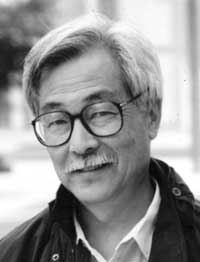
“You react physically to a work of art. When you break out in goose pimples, then you know you have something.” – Allen Say, n.d.
Summary: Grandfather’s Journey is the story of a Japanese immigrant’s journey to America as told through the memories of his grandson, Allen Say. The story of Say’s grandfather is beautifully told, depicting a love for both America and Japan. The story end with Say, himself, travelling to California to follow in his grandfather’s footsteps.
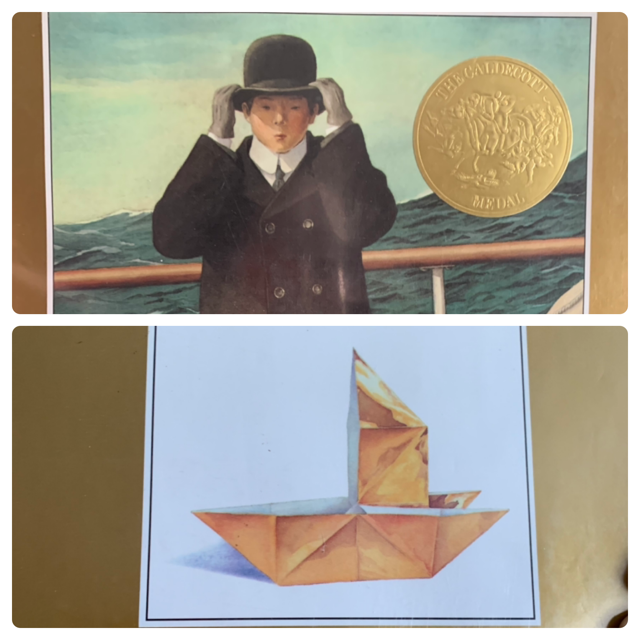
Elements of Writing: Immediately upon picking up a copy of Grandfather’s Journey, the reader is met with a watercolor painting of a man, on a ship, dressed in old-timey clothes. The back cover depicts an origami boat that seems older and weathered, as well. These two believable, yet nontraditional illustrations draw the reader in, peaking one’s interest as to what the pages might entail.
Similarly, throughout the entire book, each page is beautifully decorated with a carefully- crafted water color illustration which takes up most of each page, save for one or two sentences at the bottom. Each image supports the writing on each page, as well as the overall setting, in an interesting way, yielding “a more powerful experience than either alone” (Tunnell, Jacobs, Young, & Bryan, 2016). The watercolor format of the illustrations also embody the feeling of a memory, intact in one’s mind, but slightly blurred around the edges.
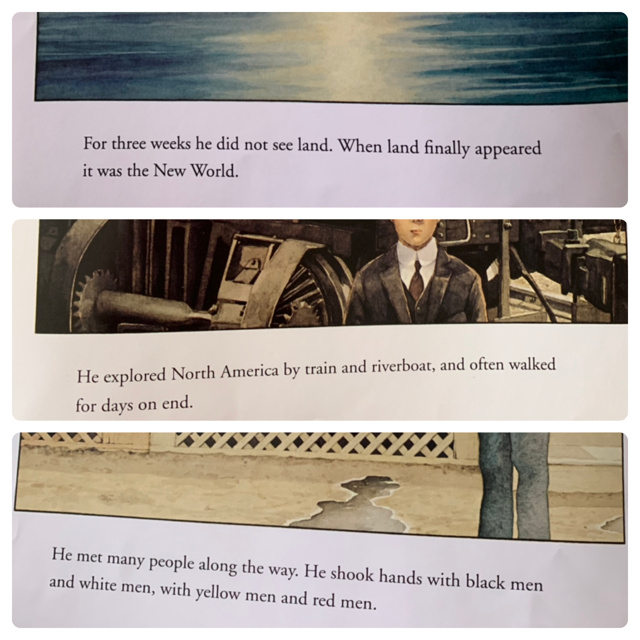
Say’s incorporation of precise vocabulary, accompanied by meticulous illustration, allows the reader to be transported back in time. For example, he uses words like “the New World” to describe America and references “trains, riverboats, and walking” as modes of transportation. He also describes meeting new people, calling them “black, white, red, and yellow” men.

Figurative language is utilized by Say to convey feelings to the reader; in other words, “showing” the reader instead of “telling” him or her. Strong and meaningful verbs are used to describe grandfather’s experiences; words like “marveled,” “astonished,” “journeyed,” “explored,” “amazed,” “reminded,” “bewildered.” The use of imagery and description gives power and insight (Tunnell, Jacobs, Young, & Bryan, 2016) to grandfather as an adventurer, with a wanderer’s heart, as seen on pg. 13, “never thought of returning home.”
The very end of the book brings both understatement and unexpected insights to the reader’s experience. Page 29 reads, “The last time I saw him, my grandfather said that he longed to see California one more time. He never did.” This incredibly moving couple of sentences understates the notion that grandfather had passed away before following up on his desires; a turn of events inferred by the reader without explicitly being said. In this way, the reader can become a participant in this moment, without being directly guided (Tunnell, Jacobs, Young & Bryan, 2016). Unexpected insights follow this with the final page reading, “I think I know my grandfather now.” This final sentiment connects the reader to the human experience of learning about one’s ancestors and struggling with the death of a family member, while also ultimately providing credibility to the author.


Active Learning & Construction of Knowledge: Grandfather’s Journey quite literally represents the construction of knowledge that each one of us experiences in some way. In other words, we all have a heritage and ancestors that have influenced our existence and made it possible to live the lives we do today. Our ancestors made decisions that continue to influence us, and we are the sum of those decisions.
This text provides the opportunity for students to question, discuss/theorize, practice inquiry, experience a contextualized/authentic/real-world text, and actively construct the story in their minds, especially when confronted with unexpected insights at the closing of the book. All of these tenants are markers of constructivism in the classroom.
Through this picture book, Say prompts the reader to reflect on his or her own experience with issues concerning relatives, war, immigration, death of a family member, moving to a new place, etc. , while also forcing the reader to consider different perspectives on the same memories and confront one’s schema/pre-conceived notions in the process.
References:
- About Allen Say. (2019). Retrieved June 15, 2019, from http://www.houghtonmifflinbooks.com/authors/allensay/author.shtml
- Say, A. (1993). Grandfather’s journey. New York, NY: Houghton Mifflin Harcourt.
- Tunnell, M. O., Jacobs, J. S., Young, T. A., & Bryan, G. (2016). Children’s literature, briefly (6th ed.). Upper Saddle River, NJ: Pearson.